
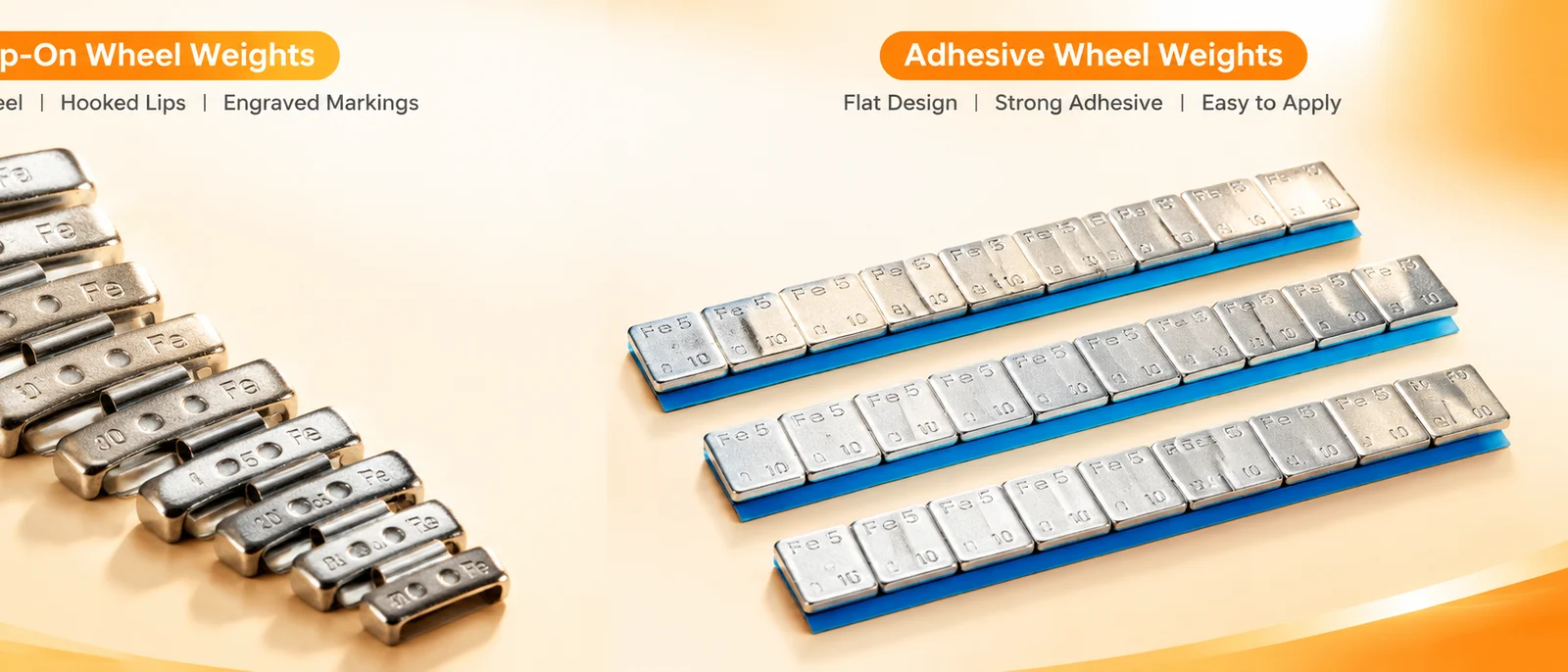
Wheel balancing weights are a small but critical part of every tyre service. Choosing the right type for your customer's wheel is the difference between a smooth, vibration-free ride and premature tyre and suspension wear. This guide explains the two decisions that matter most - material and mounting type - and how to build a range that covers the wheels your market actually services.
Why balancing matters
An unbalanced wheel produces vibration that accelerates tyre wear and puts extra load on wheel bearings and suspension components. The balancing machine tells the technician exactly where and how much weight to fit; the weight corrects the imbalance. Because the weight is the only part the workshop consumes on every service, it is one of the highest-turnover items a distributor can stock.
Fe vs Zn vs Pb: which material?
We manufacture wheel balancing weights in three materials:
- Fe (steel) - cost-effective and zinc plated for rust resistance. Available with zinc plated, epoxy coated or black coated finishes. The most popular choice for high-volume markets.
- Zn (zinc) - premium corrosion resistance for regions with harsh weather and road salt.
- Pb (lead) - the traditional choice, offering excellent vibration damping properties.
| Material | Density | Compliance | Typical positioning |
|---|---|---|---|
| Fe (steel) | About 7.8 g/cm³ | Lead-free; accepted worldwide | Standard range for alloy and steel wheels |
| Zn (zinc) | About 7.1 g/cm³ | Lead-free; strong in Europe | Premium and OE-oriented ranges |
| Pb (lead) | About 11.3 g/cm³ | Restricted or banned in some markets | Legacy markets where still permitted |
Weight is identical for a given size regardless of material, so the choice comes down to price point, local regulations and corrosion requirements. Always confirm what your market allows - lead (Pb) is restricted or banned in the EU, the UK, Canada and several US states, which is why steel and zinc ranges now dominate export demand.
Clip-on vs adhesive: which mounting type?
| Feature | Clip-on | Adhesive (stick-on) |
|---|---|---|
| Mounting position | Rim flange (outer edge) | Inner barrel of the rim |
| Best for | Steel wheels, some alloy and truck rims | Alloy and aluminum wheels |
| Appearance | Visible on the rim edge | Hidden behind the wheel face |
| Typical weight range | 5 g to 500 g depending on profile | Mainly 5 g to 60 g |
| Installation | Needs the correct clip profile for the rim | Needs a clean, dry surface |
The rule is simple: steel rims take clip-on weights, alloy rims take adhesive weights. If you buy or stock adhesive (stick-on) weights in volume, see our adhesive wheel weights wholesale buying guide.
Clipping profiles matter
Clip-on weights are not one-size-fits-all. The metal clip must match the rim flange profile, and the most common types are FN / FNC (for alloy rims), MC (steel rims), AW (alloy) and heavy-duty T-series for trucks. Supplying the wrong profile means the weight will not seat properly and can fly off. Match the profile to the wheels your customers service, and stock a mix rather than a single type.
Weight range and series
Our wheel balancing weights range from 5 g to 500 g and are available in both gram and OZ series, covering passenger cars, light trucks, buses and commercial vehicles:
- Adhesive strips - 5 g to 60 g in segments (typically 4 x 5 g + 4 x 10 g, or 12 x 5 g).
- Clip-on car weights - 5 g to 60 g in round and right-angle profiles.
- Truck weights - up to 500 g for steel commercial wheels (see the truck wheel weights guide).
Buyers in the US and some export markets order in ounces, so most factories offer both series. For the full conversion table, see our wheel weight gram to OZ conversion chart.
Packing and private label
We supply wheel weights in standard cartons or retail-ready packing, with private label branding available for distributors. Adhesive weights are usually packed 100 pcs / 50 pcs per box, and clip-on car weights in the same quantities, while truck weights are packed 50 pcs / 25 pcs.
Looking for a supplier? See our global guide to wheel weight manufacturers, browse the full wheel balancing weights range, or contact our team for a quote.
- Directive 2000/53/EC on end-of-life vehicles - lead restriction background for balance weights
- Material density and product specifications: Century Auto Parts published product data