
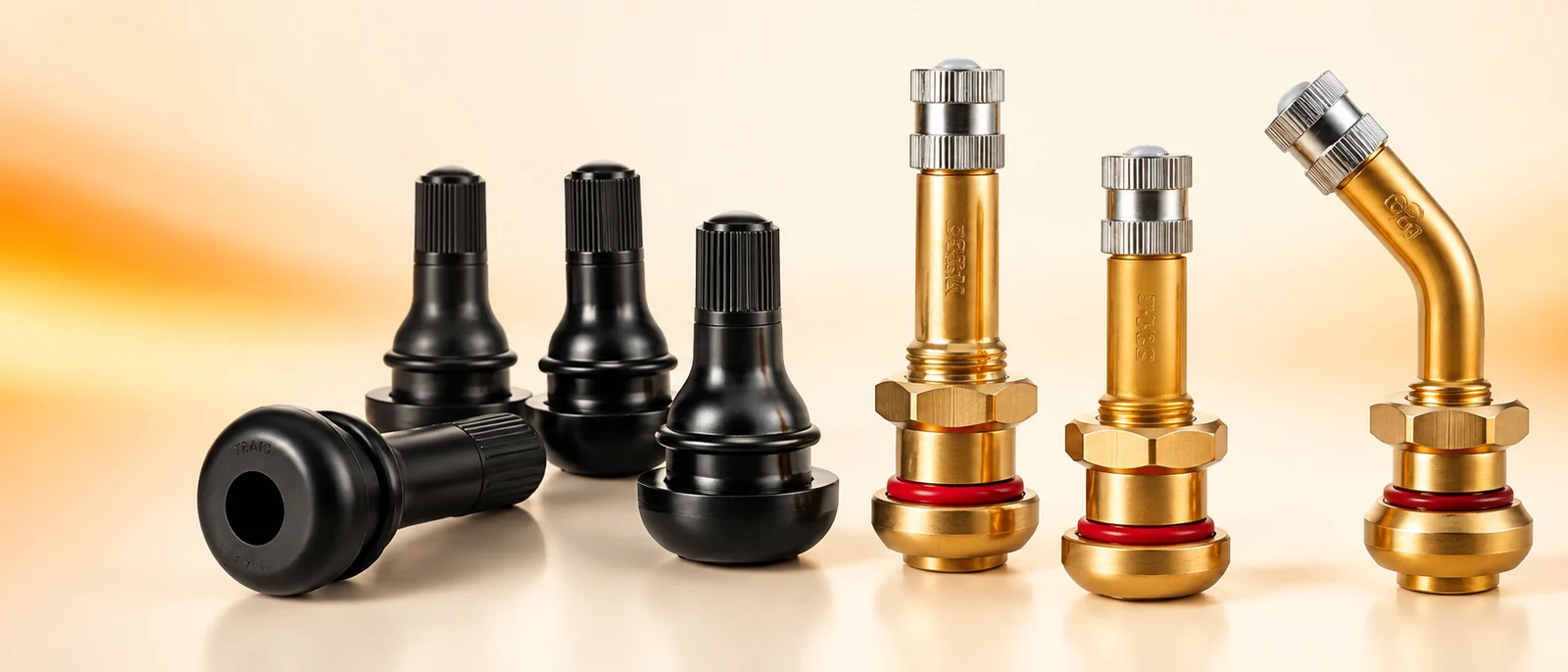
A tyre valve looks like a small, low-cost part, but it is the component that keeps air inside the tyre and lets you inflate it. Valves are identified by series numbers that describe the application, rim hole diameter and stem style. For distributors, stocking the right series is the difference between a complete range and a wall of customer returns. This guide covers the main series we manufacture and how to match them to the vehicles your customers service.
What a tyre valve is made of
Almost every valve shares the same four parts, and each can be specified separately:
- Stem - the body, either rubber (snap-in), metal (clamp-in) or a metal stem over-moulded with rubber.
- Valve core - the spring-loaded mechanism that lets air in and seals it out. The 9002# core is the standard for most passenger and commercial valves - see our tyre valve core guide.
- Cap - the dust seal. A plastic cap such as VC8 keeps dirt and moisture out of the core - see the tyre valve cap guide.
- Seal / grommet - the rubber washer that seals the valve against the rim hole.
Most field failures are not caused by the metal or rubber body but by a tired valve core or a hardened seal, so specify these parts as carefully as the stem itself.
Passenger car and light truck valves (TR series)
The TR412 to TR415 family is the workhorse range for passenger cars and light trucks. All four share the same 11.5 mm (.453") rim hole and differ mainly by effective length, which is chosen so the valve stem sits correctly for the wheel and any trim fitted.
| Model | Ref. No. | Rim hole | Effective length | Core | Cap |
|---|---|---|---|---|---|
| TR412 | V2.03.6 | 11.5 mm / .453" | 22 mm / 0.88" | 9002# | VC8 |
| TR413 | V2.03.1 | 11.5 mm / .453" | 32 mm / 1.25" | 9002# | VC8 |
| TR414 | V2.03.2 | 11.5 mm / .453" | 38 mm / 1.50" | 9002# | VC8 |
| TR415 | V2.03.3 | 15.8 mm / 0.625" | 32 mm / 1.25" | 9002# | VC8 |
The TR414C is a high-pressure variant of the TR414 built for a 65 PSI rating, making it a good choice for light commercial and trailer applications where standard passenger valves would be marginal. See the full passenger car & light truck valve range, or the complete tyre valve size and dimension chart.
Motorcycle and scooter valves (PVR series)
The PVR40, PVR50, PVR60 and PVR70 valves are bent-stem valves for motorcycle and scooter wheels. They are matched to the rim by the valve hole diameter, and all are rated to 65 PSI with a 45° or 90° bend so the stem clears the brake and rim.
| Model | Valve hole diameter (mm) | Max pressure | Bend |
|---|---|---|---|
| PVR40 | 8.8 - 9.5 | 65 PSI | 45° / 90° |
| PVR50 | 9.5 - 10 | 65 PSI | 45° / 90° |
| PVR60 | 10 - 10.5 | 65 PSI | 45° / 90° |
| PVR70 | 11.5 | 65 PSI | 45° / 90° |
Because motorcycle rims vary so much between models, selling the PVR range as a set of four hole sizes lets a workshop cover almost every machine without ordering specific part numbers.
Truck and bus valves
Commercial truck valves are metal, clamp-in designs that hold high pressure and survive far more heat cycling than a rubber snap-in valve. As a commercial truck valve factory in China, we split these into two families: the high-pressure bus valves and the TR570-TR572 truck series.
| Model | Ref. No. | Valve hole / length | Material | Bend |
|---|---|---|---|---|
| V3-20-4 | - | Φ16 x 90 mm | Brass | 27° |
| V3-20-6 | - | Φ16 x 115 mm | Brass | 27° |
| V3-22-1 / 58MS | - | Φ16 x 58 mm | Brass | 45° |
| TR570 | V3.21.4 | Φ19 x 84 mm | Brass | Straight |
| TR571 | V3.21.5 | Φ19 x 90 mm | Brass | Straight |
| TR572 | V3.21.6 | Φ19 x 100 mm | Brass | Straight |
| TR570C | V3.21.9 | Φ19 x 84 mm | Brass | 90° or 27° |
| TR571C | V3.21.10 | Φ19 x 90 mm | Brass | 90° or 27° |
| TR572C | V3.21.11 | Φ19 x 100 mm | Brass | 90° or 27° |
| MS70-7 (70MS-7) | - | 40.5 + 29.5 mm | Ni-plated brass | 7° |
The "C" suffix denotes a bent-stem version for wheels where a straight valve would be hard to reach or could catch on a hubcap or brake component. The 58MS is the classic high-pressure bus valve with a 45° bend, while MS70-7 is a nickel-plated heavy-duty valve for commercial and off-highway use.
Agricultural and off-road valves
Agricultural and off-highway tyres run at lower speeds but high loads and often carry liquid ballast, so their valves are larger and more robust than truck valves.
| Model | Ref. No. | Size / length | Core | Cap | Hole / bend |
|---|---|---|---|---|---|
| TR618A | V5.01.1 | Φ22.5 x 30 mm | - | - | 5/8" hole, 90 PSI |
| TRJ650-02 / 03 | V5.04.1 | Large bore swivel | 7002 | VC6 | 20.5 mm rim hole |
| TR1175A | - | Φ22.5 x 24 mm | 9002 | - | 20.5 mm rim hole, 86° |
The TRJ650-02/03 is a large-bore swivel valve for tractors, letting the valve head rotate for easier inflation on wide rims with liquid ballast. The TR1175A is an extra-large off-road valve for heavy machinery.
Which to stock: rubber snap-in vs metal clamp-in
Buyers comparing the different types of tyre valves usually decide between the two constructions first:
| Rubber snap-in (metal-free body) | Metal clamp-in (brass) | |
|---|---|---|
| Typical fitment | Passenger cars, light trucks, motorcycles - the mainstay types of car tyre valves | Trucks, buses, agricultural and high-speed wheels |
| Mounting | Pressed into the rim hole by hand or tool | Through the rim hole, secured with a nut |
| Strength profile | Flexible, economical, easy to replace | Withstands higher pressure and heat cycling |
| Examples | TR412-TR415, PVR40-PVR70 | V3-20, TR570-TR572, 58MS, TR618A |
The types of car tyre valves a distributor needs are overwhelmingly the rubber snap-in TR series; metal clamp-in valves serve commercial and agricultural accounts. Many ranges pair both with the same 9002# core, which simplifies spare-part stocking.
When to replace tyre valves
Tyre valve replacement is cheap insurance. Industry practice is to fit a new snap-in valve (or at minimum a new core, cap and seal) every time a tyre is replaced, and to replace any valve immediately if you see:
- Cracking, perishing or hardening of the rubber body - typical on valves older than 4-6 years;
- Bubble-test leaks at the stem base (the rim seal) or the valve mouth (the core);
- A bent metal stem or a stripped cap thread;
- Corrosion on clamp-in valves after winter service;
- Any vibration damage after a kerb strike or wheel repair.
For TPMS-equipped wheels, replace the service kit (stem, core, seal, grommet and nut) at every tyre change - the TPMS maintenance guide covers the details.
How to choose the right series
- Match the rim hole. The rim hole diameter is the first hard constraint - 11.5 mm for most car valves, 15.8 mm for TR415, 20.5 mm for large agricultural valves.
- Check the pressure rating. Standard passenger valves are rated around 65 PSI; truck, bus and high-pressure valves are built for higher loads.
- Choose the stem length and bend. Longer stems suit deep-drop rims and wheel covers; bent (C-suffix) stems reach valves hidden behind spokes or brakes.
- Confirm the temperature range. Rubber snap-in valves are the economical choice for cars; metal clamp-in valves handle the heat cycling of commercial service.
- Specify the core and cap. 9002# cores and VC8 caps cover the majority of applications; agricultural and TPMS designs use others.
Buying notes for distributors
- Stock both rubber and metal valves - one range serves cars, the other serves trucks, buses and off-road.
- Offer valves with and without cores and caps, and sell the cores and caps separately as consumables.
- Keep the TR412/413/414 trio in depth; they cover the vast majority of passenger-car fitments.
- Ask your supplier for batch dimensional checks, since a valve that is a fraction short can leak at the rim seal.
See the full tyre valves range, including truck & bus valves and agricultural & off-road valves. For pressure monitoring, see our TPMS valve stems and the TPMS maintenance guide.
- ETRTO standards for rim hole diameters and valve fitment (reference values for valve sizing)
- Product dimensions, materials and pressure ratings: Century Auto Parts published product specifications