
Tubeless Tire Valves Wholesale: The Complete Bulk Buyer’s Guide
The Wholesale Opportunity in a Small Component
Every tubeless tyre sold anywhere in the world needs a valve, and every valve has a finite service life. Industry convention recommends replacing the valve with every tyre change, which means global demand tracks tyre replacement volume — hundreds of millions of units per year. For distributors, tubeless tire valves wholesale is a rare combination: a consumable with guaranteed repeat demand, negligible storage cost, and a product range compact enough for a single pallet to represent a complete programme.
The margin structure rewards specialists. Passenger car snap-in valves move in high volume at modest margins, while truck, agricultural and specialty clamp-in valves carry significantly better percentages. A well-structured wholesale range captures both. This guide walks through the decisions that determine whether a wholesale valve programme earns money or collects dust.
Snap-In vs Clamp-In: Understanding the Two Categories
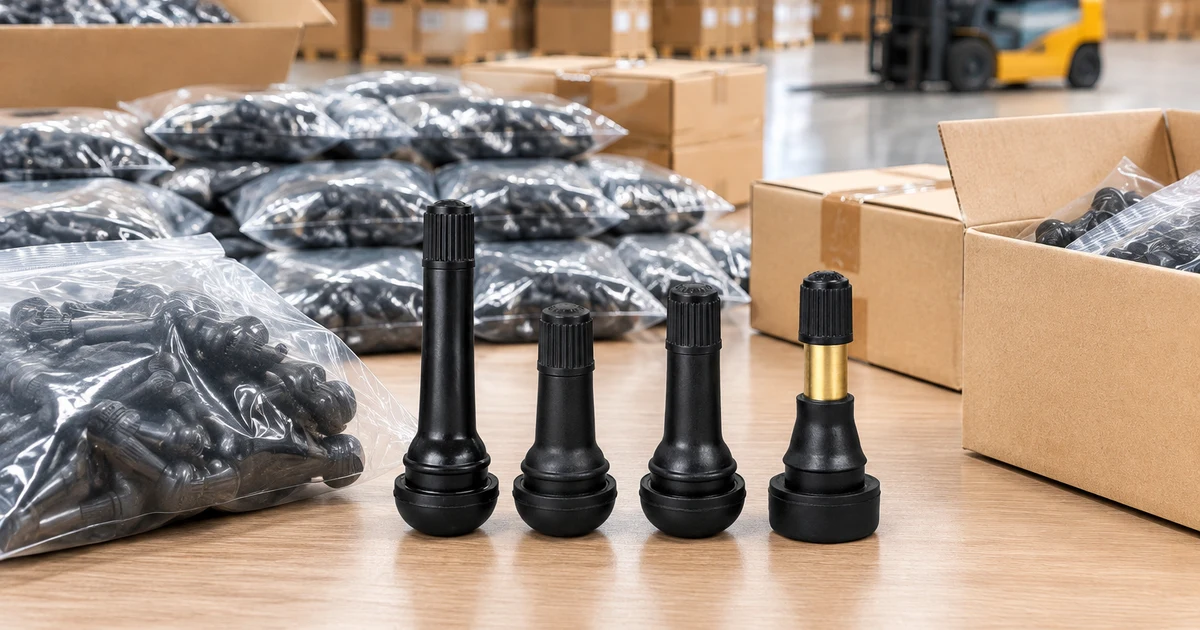
Rubber snap-in valves — the TR412 through TR425 families — are the volume backbone of the market. They press into the rim hole by hand or with a simple tool, seal with a molded rubber grommet, and serve the vast majority of passenger cars and light trucks. Wholesale economics here are pure velocity: the TR414 alone likely outsells every other model in your warehouse combined.
Brass clamp-in valves serve the segments snap-in valves cannot: alloy wheels that demand metal stems, trucks and buses running higher pressures, agricultural machinery, and any application where the seal must be serviceable. The V3-20 series, TR500-TR575 range and nickel-plated TR552-TR557 families dominate this space. Volumes are lower, but margins per unit are five to fifteen times higher than snap-in valves.
A balanced wholesale programme typically runs at roughly eighty percent snap-in and twenty percent clamp-in by unit volume — but closer to fifty-fifty by gross margin. New entrants often underweight clamp-in valves because the SKUs feel unfamiliar; that is precisely where the profit hides.
Rim Hole Standards: The Specification You Cannot Get Wrong
Two rim hole diameters dominate the passenger market: 11.5mm (.453 inch) for most cars and 15.9mm (.625 inch) for light trucks, some SUVs and trailers. Ordering a container of 15.9mm valves for a market that runs 11.5mm is the classic wholesale mistake — the stock is perfectly good and completely unsellable.
Clamp-in valves add more variety: passenger clamp-in valves share the 11.5mm hole, truck and bus valves commonly fit Φ9.7mm, Φ16mm or Φ19mm holes depending on region and rim standard, and agricultural large-bore valves use Φ20.5mm and Φ22.5mm seats. Before finalizing any wholesale order, map your target market’s vehicle parc against rim hole standards, and ask your supplier for the ETRTO cross-reference table if you are unsure.
Rubber Quality Decides Shelf Life — and Claims
Snap-in valves are rubber products first and foremost, and rubber ages. EPDM-based compounds with proper anti-ozonants stay flexible from -40°C to +100°C and remain serviceable for years in the box and on the rim. Low-cost natural rubber blends look identical on day one but harden, crack and leak within months — usually after your customer has mounted the tyre.
When comparing wholesale quotations, ask every supplier for the compound specification and the accelerated aging test standard they apply. The price gap between genuine EPDM valves and economy rubber valves is real but small; the claims gap is enormous. Also check storage conditions at your own warehouse: keep valves away from electric motors, welders and direct sunlight, all of which accelerate ozone cracking.
High-Pressure and Specialty Lines Worth Stocking
Beyond the passenger core range, several product families consistently outperform for wholesale distributors. High-pressure snap-in valves — TR600HP, TR602HP, TR801HP and TR802HP — serve light trucks and trailers running elevated pressures and are increasingly specified by tyre shops as standard replacements.
On the commercial vehicle side, nickel-plated clamp-in valves with O-ring seals (TR552-TR557 and TR542-TR547 series) and European-style V3.12 to V3.19 series valves move steadily to fleet customers. Motorcycle valves (PVR series in 45° and 90° bends) and valve extensions for dual wheels round out a programme. None of these need deep stock — two months of cover is enough — but their presence makes your catalogue a one-stop offer, which is what keeps tyre shops loyal.
How to Structure Your First Wholesale Order
A proven first-order structure for a new market allocates roughly sixty percent of units to passenger snap-in valves (led by TR414 and TR413), twenty percent to light truck and high-pressure lines, and twenty percent to clamp-in, motorcycle and specialty valves, with valve caps and cores added as attachment items — caps and cores typically add two to four percent to order value at almost no freight cost.
Resist the urge to over-order slow models to hit price breaks. A valve that sits in your warehouse for eighteen months costs more in capital and space than the discount earned. Instead, negotiate mixed-model container terms with your supplier up front: most established factories support thirty to fifty models per container with reasonable per-model minimums.
Packaging, Freight and Customs Practicalities
Wholesale tubeless valves ship in polybags of one hundred or five hundred pieces inside double-wall export cartons. The product tolerates sea freight well, but insist on palletized, shrink-wrapped cartons — loose cartons in a humid container arrive with surface corrosion on brass parts that customers will reject.
At roughly twenty-five kilograms per thousand snap-in valves, a twenty-foot container holds three to four million valves, which compresses unit freight cost to a fraction of a cent. Harmonized codes typically fall under HS 8481.80 (valves) with country-specific variations; an experienced supplier will have shipped your destination before and can flag documentation requirements — certificates of origin, fumigation declarations where applicable — before the booking is made.
Wholesale Pricing Tiers and How They Really Work
Wholesale valve pricing is driven less by volume brackets than by order composition. A container of pure TR414 earns a better unit price than a container of fifty mixed models, because changeover time on automatic lines is the real cost driver. Smart buyers therefore negotiate two price lists with their supplier: a sharp price for the ten commodity models they reorder monthly, and a fair but less aggressive price for the specialty tail.
Beware of quotations that look attractive because they quietly assume full-container quantities of a single SKU applied to a mixed order. Ask every supplier to quote your actual planned order structure — the same models, same quantities — so comparisons are honest. The cheapest headline price on an order you will never place is worth nothing.
Regional Demand Differences to Plan Around
Valve demand is not globally uniform. North America runs heavy on TR414 and high-pressure light truck valves; Europe adds significant clamp-in volume for alloy wheels and TPMS service; the Middle East rewards high-temperature cores and heat-resistant compounds; Southeast Asian motorcycle markets drive PVR bend valves in 45° and 90°. Agricultural regions add seasonal spikes for tractor and implement valves around planting and harvest.
Map your market before your first purchase order, and revisit the map annually — vehicle parc shifts, TPMS penetration and alloy wheel adoption all move valve demand. A supplier who understands these regional patterns can sanity-check your order structure and flag items you may be missing.
Five Wholesale Mistakes That Burn New Distributors
First: buying only on unit price and discovering the rubber compound fails in your climate. Second: ordering deep stock of slow specialty models before any demand is proven. Third: forgetting caps and cores as attachment items — they ride the same container almost free and lift every invoice. Fourth: accepting loose, unpalletized cartons that arrive moisture-damaged. Fifth: never testing a sample from the actual production batch before the container ships.
Each of these mistakes is cheap to prevent and expensive to fix. Build them into a one-page pre-shipment checklist and your wholesale programme avoids the painful education most distributors pay for in their first two years.
OEM Branding: Turning a Commodity into Your Brand
Wholesale valves are nearly invisible to end users, which makes branding the packaging the smartest margin lever available. Printed polybags with your logo and barcode, color-coded boxes by valve family, and laser-marked caps transform a commodity into a branded programme that tyre shops reorder by name. OEM packaging typically adds one to three percent to order value while measurably lifting reorder rates.
Plan branding early in the supplier conversation: artwork approval, packaging samples and barcode verification add one to two weeks to the first order. Lock the specification once — bag size, print colors, carton marks — and every subsequent reorder becomes automatic.
Decoding the Model Numbers: TR, V and PVR
Wholesale catalogues are dense with model codes, and understanding them speeds up every order. TR numbers trace to Tire and Rim Association standards: TR412-TR425 are snap-in lengths, TR5xx are truck clamp-ins, TR6xx are large-bore and agricultural valves. V-prefixed numbers (V3-20, V3.12-V3.19) come from European rim standard conventions for clamp-in valves. PVR designates motorcycle valves, with the suffix angle — 45° or 90° — describing the bend.
You do not need to memorize the system, but your order template should carry full model numbers plus effective length and rim hole for every line. Ambiguity between "TR414" and "TR414L" (56.5mm versus 38mm) has stranded more than one shipment in the wrong warehouse.
Reading a Supplier’s Quotation Like a Professional
A wholesale quotation tells you more than prices. Look for per-model MOQs stated explicitly, lead time quoted in days with a shipment reference point ("after deposit and artwork approval"), packaging details down to bag and carton counts, validity period, and the Incoterm. Quotations missing these elements are estimates, not offers, and they renegotiate themselves at the worst moments.
Compare quotations line by line against the same order structure. Some suppliers shade prices on the fast movers and recover margin on specialty items; others do the reverse. Only the total landed cost of your actual basket is comparable — and that number is invisible until you normalize the structures.
The Wholesale Buyer’s Bottom Line
Success in tubeless tire valves wholesale comes down to four disciplines: know your market’s rim holes, buy EPDM rubber with test data to prove it, balance your range across snap-in volume and clamp-in margin, and structure orders for velocity rather than price breaks. Get those right and valves become the most predictable line in your catalogue.
Century AutoParts supplies tubeless tire valves wholesale to distributors in more than fifty countries, with mixed-model containers, EPDM compounds verified by aging tests, and full OEM packaging support. Contact us for the wholesale price list and current stock availability.
Frequently Asked Questions
Need Tyre Valves?
Get a factory-direct quote for your order requirements. We reply within 24 hours.