
How to Choose a Tyre Valves Manufacturer in China: A Complete Buyer’s Checklist
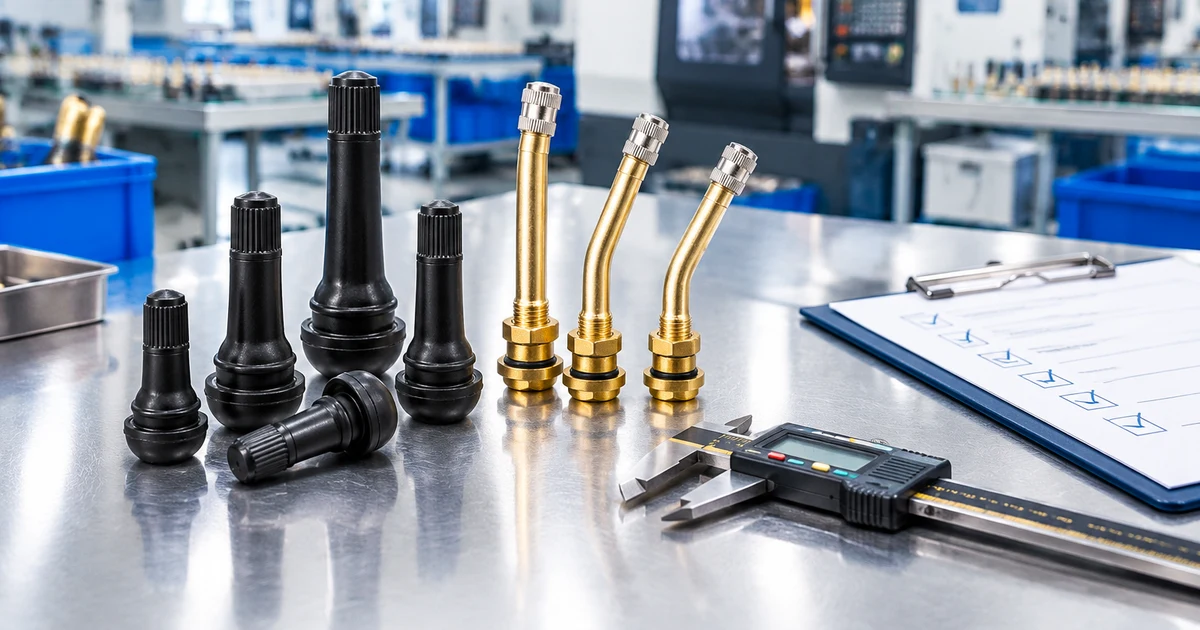
Why the Manufacturer Matters More Than the Price
Tyre valves are among the smallest components on a vehicle, yet they carry full inflation pressure every kilometre the vehicle drives. A valve core that seeps air or a rubber stem that cracks after one hot summer does not just create a warranty claim — it can damage the distributor relationship you spent years building. This is why experienced importers evaluate the tyre valves manufacturer first and negotiate the price second. The purchase price difference between a top-tier factory and a mediocre one is often less than two cents per valve, while the cost of a single container of defective valves, once freight, duties and reputation damage are counted, can exceed ten thousand dollars.
China produces the majority of the world’s tyre valves, and Hebei province in particular has developed into a cluster of valve factories, from three-machine workshops to fully automated plants. The spread of capability inside this cluster is enormous, which makes a structured evaluation process essential. The checklist below is the same framework our own export customers tell us they used before placing their first order with us, refined over more than a decade of B2B supply.
1. Check Material Traceability
Materials determine eighty percent of a valve’s service life, so start here. For brass clamp-in valves, ask which brass grade the factory machines — H62 and H65 brass are the accepted industry standards because their copper content gives the right combination of machinability, strength and corrosion resistance. Some low-cost workshops substitute recycled brass with inconsistent zinc content, which machines faster but corrodes earlier and can crack at the hex flats under torque.
For rubber snap-in valves, the question is the compound. EPDM-based compounds resist ozone, ultraviolet light and temperature cycling far better than natural rubber blends. Ask the manufacturer for the compound specification sheet and the accelerated aging test results. A serious tyre valves manufacturer will provide exact material data within a day; a factory that answers with phrases like "good quality rubber" is telling you something important.
2. Ask About Leak Testing and In-Process QC
Every finished valve is a pressure vessel in miniature. The industry baseline is one hundred percent air-tightness testing on assembled valves — not batch sampling. Ask how the test is performed (underwater bubble test or decay test), at what pressure, and whether results are recorded per production batch so a defect found in the field can be traced back to a date and a machine.
Beyond final testing, look at in-process controls: incoming inspection of brass bar and rubber compound, first-article inspection at each shift start, and statistical process checks on critical dimensions like thread gauges and rim seat diameters. Factories that can show you these records without preparation are running a real quality system; those that need a week to "collect documents" are usually improvising.
3. Verify Real Production Capacity
Capacity is not just about how many valves a factory can make in a good month — it is about whether your order still ships on time in peak season. Ask for the machine list: automatic lathes for brass stems, vulcanization presses for rubber valves, and whether valve cores are produced in-house or purchased. A factory that makes its own cores controls its lead time; one that buys them is hostage to someone else’s schedule.
Also ask about the ratio of production workers to quality inspectors and the factory’s current utilization. A plant running at one hundred and twenty percent capacity will quietly subcontract your order to a neighbour — and your specifications may not travel with it. A good rule of thumb is to favour manufacturers running at seventy to eighty-five percent utilization, with visible room to absorb your growth.
4. Review MOQ and Mixed-Container Policy
For distributors, the unit price matters less than the order structure. A catalogue of one hundred and fifty models is only useful if you can buy them in realistic quantities. Ask the MOQ per model, not per order. Standard snap-in valves like TR413 and TR414 typically carry MOQs of ten thousand pieces or more at efficient factories, while clamp-in truck valves often start at two to five thousand.
Then ask the more important question: can you mix thirty or fifty models into a single container? A tyre valves manufacturer that stocks fast movers and runs a flexible production plan will say yes with clear per-model minimums. One that insists on full-carton quantities per model will force you into either overstocking slow movers or leaving gaps in your range.
5. Evaluate OEM and Private Label Support
If you distribute under your own brand — and most successful valve importers eventually do — the factory’s OEM capability becomes central. Can they laser-mark caps with your logo, print polybags with your artwork, design colour box packaging, and produce barcode labels that scan correctly at your customers’ warehouses?
Ask for photographs of previous OEM projects and, if possible, a reference customer in a non-competing market. Pay attention to how the factory handles your artwork and brand assets: a manufacturer with a disciplined OEM workflow will have a defined approval process for pre-production samples of packaging, which protects your brand from expensive misprints.
6. Confirm Certifications and Test Reports
The baseline document set for a qualified tyre valves manufacturer includes ISO 9001 certification, REACH and RoHS declarations for European shipments, and product test reports covering pull-out force, torque, salt spray corrosion and high-temperature performance. None of these are difficult for a real factory to provide.
Go one step further and ask a technical question that requires the engineering team: for example, the recommended nut torque for a TR416 clamp-in valve, or the ETRTO cross-reference for a V3-20-4. The speed and precision of the answer tells you whether the factory has real engineers or just sales agents with a catalogue.
7. Test Communication Speed and Depth
You will exchange hundreds of messages with this partner over the coming years: order confirmations, drawing approvals, shipping documents, the occasional claim. Test the channel before you need it. Send a technical inquiry on a Friday afternoon and see what Monday morning brings. A reply that answers your question with data, drawings and a clear next step signals a partner; a reply that asks you to repeat yourself signals friction you will pay for later.
Language matters less than precision. A manufacturer whose English is imperfect but whose answers are exact — with dimensions, tolerances and dates — is far safer than a fluent talker who never commits to a number.
Run a Structured Trial Order
Once a factory passes the checklist, resist the temptation to open with a full container of your entire range. Start with a trial order of your five fastest models in moderate quantities. Measure the valves against ETRTO dimensions on arrival, run a pressure-hold test on a sample, and track how the factory handles the small inevitable issues — a short-shipped carton, a label correction — because that behaviour predicts how they will handle a real problem.
Document everything and share the results with the factory. Manufacturers who welcome your inspection data are the ones worth growing with; the relationship you are building is measured in containers per year, not in single transactions.
8. Visit or Audit Before You Commit
Nothing replaces seeing the factory. If you can travel, a one-day plant tour answers questions that months of emails cannot: the real machine park, the cleanliness of the vulcanization area, how cores are stored, whether workers actually use the torque wrenches on the assembly benches. If travel is impractical, commission a third-party audit — SGS, Bureau Veritas and TÜV all offer factory audits in China for a few hundred dollars, and the report pays for itself the first time it prevents a bad commitment.
Even a video call walk-through, done live and unscripted, reveals more than any brochure. Ask to see the leak-testing station in operation and the warehouse where export cartons await shipment. The confidence or discomfort on display is genuine information.
Common Mistakes Buyers Make When Choosing a Manufacturer
The most frequent mistake is comparing quotations without comparing specifications. Two TR414 valves can differ by rubber compound, insert brass weight and cap gasket quality while sharing an identical photo. Always normalize the spec before normalizing the price. The second mistake is ignoring lead-time reliability: a manufacturer who quotes twelve days but ships in forty disrupts your customers more than one who honestly quotes thirty.
Third, buyers often skip the written specification. Put the agreed standards — compound, brass grade, test methods, packaging — into the purchase contract as an annex. When specifications live only in chat history, they evaporate the moment a dispute begins. Finally, do not concentrate one hundred percent of a critical SKU in one factory forever; qualify a backup source while the relationship is healthy, not during a crisis.
Understanding Lead Times and Seasonal Capacity
Tyre valve production has a rhythm buyers should know. Northern hemisphere tyre change seasons — spring and autumn — drive demand spikes that ripple back through factory schedules four to eight weeks earlier. A manufacturer quoting 15-20 day lead times in July may honestly need 35-40 days in October. Ask for the seasonal lead-time curve, not just today’s number, and place your pre-season orders accordingly.
Chinese New Year is the other fixed constraint: most factories close for two to three weeks around late January or February, with capacity tightening a month before. Experienced buyers place orders to cover this window by early December. A manufacturer who proactively warns you about these calendars is planning with you; one who does not mention them will surprise you with them.
Do Trading Companies Ever Make Sense?
Honest answer: occasionally, yes. A good trading company earns its margin when you need dozens of unrelated product families consolidated — valves, weights, patches and tools in one shipment with one point of contact. The premium you pay buys consolidation and their supplier network.
For a focused valve programme, however, factory-direct wins on every axis that matters: price, technical accuracy, customization speed and accountability when something goes wrong. If a trader cannot name the factory, control its schedule or sign its test reports, their margin is buying you risk, not service. Most mature distributors end up factory-direct for their core lines once volumes justify it.
About Century AutoParts
Century AutoParts is a tyre valves manufacturer located in Cangzhou, Hebei province, in the heart of China’s valve production cluster. Since 2010 we have produced rubber snap-in valves, brass clamp-in valves, truck and bus valves, agricultural and off-road valves, valve extensions, caps and cores, exporting to more than fifty countries across Europe, the Americas, the Middle East and Southeast Asia.
We welcome the checklist above: material certificates, one hundred percent leak testing records, mixed-container MOQ policies and full OEM/ODM support are part of our standard export workflow. If you are evaluating tyre valves manufacturers for your market, contact us for a catalogue, samples and a quotation — we reply to technical inquiries within twenty-four hours.
Frequently Asked Questions
Need Tyre Valves?
Get a factory-direct quote for your order requirements. We reply within 24 hours.