
Buying Auto Tire Valve Stems in Bulk: Materials, MOQ and Quality Control
Why Bulk Buyers Think in Systems, Not Pieces
When you buy auto tire valve stems in bulk, you are not really buying a hundred thousand small parts — you are buying a failure rate. A container of valves with a 0.5% defect rate means five hundred potential flat tyres, and your customers will remember every one of them. Bulk purchasing therefore runs on different rules than spot buying: specifications are written down, quality is verified statistically, and total cost is measured per installed, trouble-free valve rather than per unit price.
This guide condenses what experienced importers check when committing to bulk volumes, from material selection through to the ten-minute incoming inspection that has saved more than one distributor from a disastrous quarter.
Material Systems: Rubber, Brass and Plated Variants
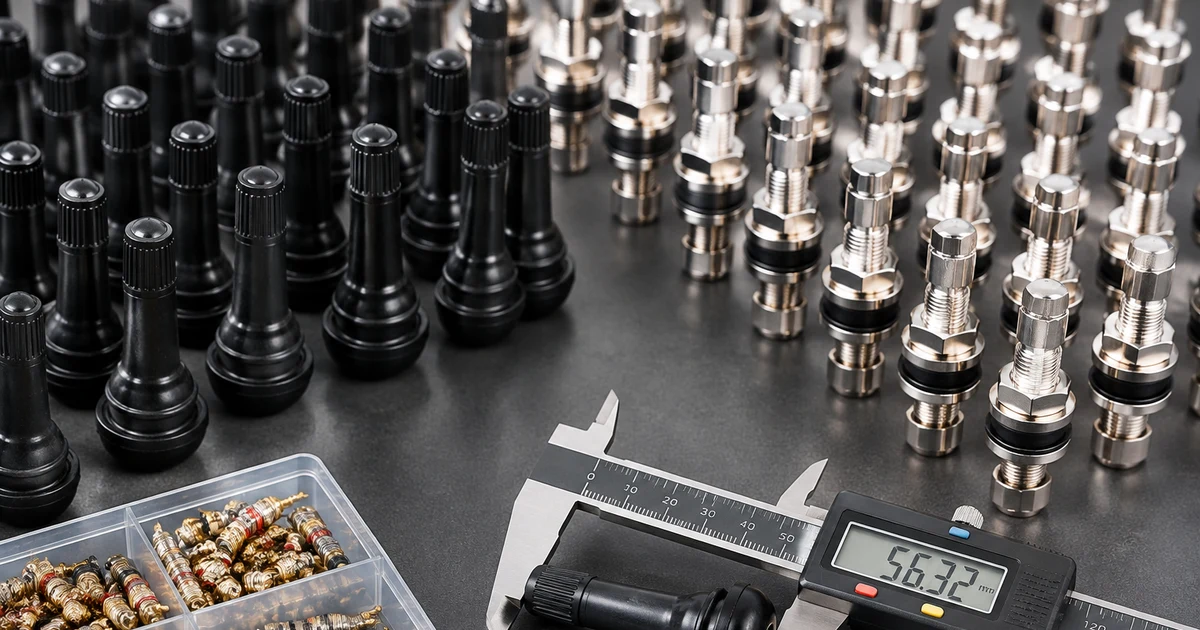
Bulk valve stems divide into three material systems. Rubber snap-in stems pair an EPDM body with a brass insert and dominate passenger car volume. Full brass clamp-in stems with nut, washer and grommet serve alloy wheels, trucks and high-pressure applications where the seal must be serviceable. Chrome or nickel-plated finishes on brass stems add corrosion resistance for coastal and winter-salt markets — a real differentiator in Scandinavia, Canada and the northern US.
The material decision is market-driven, not price-driven. Northern Europe and North America reward plated clamp-in stems; tropical high-volume markets reward EPDM snap-in quality; fleet customers want nickel-plated truck valves with O-ring seals. Build your bulk mix around your customers’ vehicles, and ask suppliers for material certificates with every quotation so substitutions are visible.
The Mechanical Numbers That Matter
Two test numbers predict field reliability better than any brochure. Pull-out force for snap-in valves — the force required to push the valve back through the rim hole — should meet or exceed 400N under the relevant ETRTO test. Clamp-in nut torque specifications, typically 3-5 Nm for passenger clamp-in valves and higher for truck valves, determine whether the seal holds without cracking the rim finish.
Core performance is the third number: working pressure 0-15 kgf/cm² (0-212 PSI) is the industry norm, with high-temperature cores rated -54°C to +150°C for extreme climates. Reputable bulk suppliers provide batch test reports covering all three. If a quotation does not mention test data, ask — the response will tell you whether you are dealing with a manufacturer or a reseller.
Cores and Caps: The Attachments That Prevent Claims
Every valve stem ships with a core and a cap, and in bulk purchasing these attachments deserve explicit attention. Standard 9001 cores serve temperate markets; high/low temperature 9002 cores with red seals are worth their small premium in hot climates and for commercial vehicles. Caps must include a sealing gasket — a cap is the second seal of the system, not just a dust cover.
Colored caps (red, green, blue) and chrome or brass cap options are inexpensive attachment sales that tyre shops actively want. Plan them into the bulk order from the start; adding a cartons-of-caps line item later costs more in freight than the caps themselves.
MOQ Planning by Sales Velocity
Minimum order quantities exist because of tooling and setup economics, and they differ sharply by valve family. Rubber snap-in valves on automatic lines typically carry MOQs around ten thousand pieces per model; brass clamp-in stems on lathes start nearer two to five thousand; specialty agricultural or large-bore items may be lower still but with longer lead times.
A workable stocking rule for bulk buyers: hold three to four months of the fastest movers (TR414, TR413 and their regional equivalents), two months of mid-velocity truck and clamp-in lines, and order specialty items against visible demand rather than forecast. This structure keeps working capital deployed where it turns, and lets you accept mixed-container terms without drowning in slow stock.
Incoming Inspection: Ten Minutes per Carton
Bulk quality control does not end at the supplier’s gate — it ends at yours. A simple incoming inspection catches most problems while a claim is still practical. Sample cartons from different pallets: verify rim hole fit with a gauge, run a thread gauge over clamp-in stems, submerge a dozen assembled valves under 6 bar of air and watch for bubbles, and flex rubber stems sharply to expose any cracking.
Record results per batch and share them with your supplier. Factories that receive structured feedback tighten their own processes, and your defect rate falls quarter by quarter. Suppliers who resist feedback are telling you they do not intend to improve.
Storage and Stock Rotation for Bulk Inventory
Valve stems are forgiving but not immortal. Store cartons in a cool, dry warehouse away from sunlight and ozone sources — electric motors and welding equipment are the classic ozone generators that quietly age rubber stock. Rotate inventory first-in, first-out even though shelf life is measured in years; packaging degrades faster than the product.
For plated brass stems, keep cartons sealed until needed: the polybag inside is the moisture barrier that keeps the finish bright. A bulk warehouse that manages these basics delivers valves to customers that look and perform exactly as they left the factory.
Thread Standards and Compatibility Checks
Valve stem threads look trivial until a container arrives with the wrong one. The dominant thread for standard valve cores is 8V1 (.305-32), while large-bore agricultural and OTR valves use the larger 12V1 thread and different cores entirely. Clamp-in truck valves carry their own nut and washer standards, and extension threads must match the valve mouths they serve.
For bulk orders, write the thread specification into the purchase order explicitly, especially when ordering cores, caps and extensions alongside stems. A ten-second line item prevents a ten-thousand-dollar incompatibility. When in doubt, ask the supplier to confirm 8V1/12V1 compatibility on the proforma invoice — reputable factories do this automatically.
TPMS Compatibility in a Bulk Programme
TPMS penetration keeps rising, and bulk buyers increasingly need stems and service kits that work alongside sensors. Snap-in rubber valves coexist with TPMS in most applications, but clamp-in metal stems on TPMS-equipped wheels require TPMS-rated variants with the correct grommet and torque behavior. Specialty clamp-in models such as the V3-20-4 TPMS version exist precisely for this.
Include TPMS-compatible lines in your bulk range before your market demands them — tyre shops increasingly refuse to fit non-rated hardware on sensor-equipped vehicles, and the distributor who already stocks the rated version takes the order.
The Landed Cost Math Behind Bulk Pricing
Bulk decisions should run on landed cost per sellable unit, not FOB unit price. Work the full chain: FOB price, ocean freight per unit (negligible for valves — a 20-foot container holds three to four million snap-in stems), import duty by destination HS classification, port and handling charges, warehouse cost, and an honest allowance for defects and slow movers.
Run this math for two or three candidate suppliers with their real terms. The result often reverses the FOB ranking: the factory with slightly higher prices but lower defect rates and better packing wins on landed cost every time. Buyers who only compare FOB prices are optimizing the smallest line in the equation.
Building a Simple Supplier Scorecard
Bulk relationships improve fastest when performance is measured rather than remembered. A one-page scorecard per shipment — on-time rate, defect count per million, documentation accuracy, response time — takes ten minutes per container to maintain and turns annual reviews into fact-based conversations. Share the scorecard with your supplier every quarter.
Manufacturers who engage with the numbers improve visibly within two or three shipments; those who dismiss measurement reveal their ceiling. Over a year, the scorecard also tells you when volume growth is justified — and when a backup source deserves a trial order. Bulk buying discipline is mostly this: measure, share, adjust, repeat.
Defect Allowances and Claim Procedures
Even excellent factories produce occasional defects; what distinguishes suppliers is how claims are handled. Agree on the mechanism before the first order: typical arrangements credit or replace defective units in the next shipment against photo evidence and batch numbers. A written claims procedure in the purchase contract prevents the slow email attrition that kills most quality claims.
Keep your own numbers honest. Report claims per received quantity with batch references, and the supplier can trace the defect to a production date and machine. Buyers who claim in round percentages without evidence get slow answers; buyers who send ten photos and a batch code get replacements in the next container.
Pre-Shipment Inspection: The Last Checkpoint
Between production completion and container loading sits the highest-value hour in bulk buying: pre-shipment inspection. Either your own agent or a third-party inspector pulls random samples against the AQL standard you specified — typically AQL 2.5 for major and 1.0 for critical defects on valves — and verifies quantity, marking, packaging and carton condition.
The inspection costs a few hundred dollars per container and answers the only question that matters at that moment: does this shipment match the approved samples? Suppliers behave differently when they know an inspection is standard practice, which is reason enough to make it one.
Total Cost: Why the Cheapest Container Is Rarely Cheapest
The true cost of a bulk valve stem order is unit price plus freight plus defect claims plus the working capital tied up in stock. A supplier five percent cheaper on paper who ships with a one percent defect rate has just charged you double the apparent saving, before counting a single unhappy customer. Experienced bulk buyers therefore negotiate on specification and reliability first, and let price follow.
Century AutoParts supplies auto tire valve stems in bulk direct from our Hebei factory: batch test reports with every shipment, mixed-model container support, OEM packaging, and a defect policy that puts replacements in your next container. Our range covers rubber snap-in stems, brass clamp-in stems, truck and bus valves, agricultural large-bore valves, extensions, caps and cores — one purchase order, one shipment, one accountable partner. Request the bulk price list and a sample kit to start the evaluation.
Frequently Asked Questions
Need Tyre Valves?
Get a factory-direct quote for your order requirements. We reply within 24 hours.